
Doodle God™
JoyBits Ltd.Puzzle
4.61.93K Reviews
- Version
- 3.3.16
- Installs
- 500.00K
- Age Rating
- Everyone
Screenshots
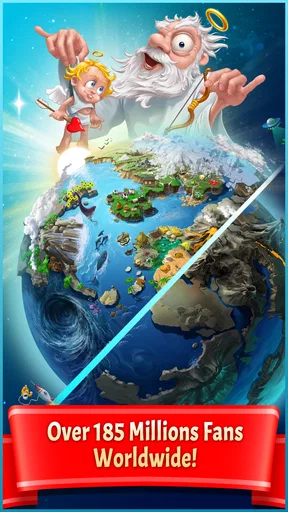
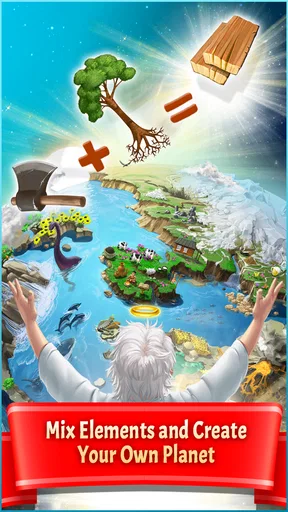
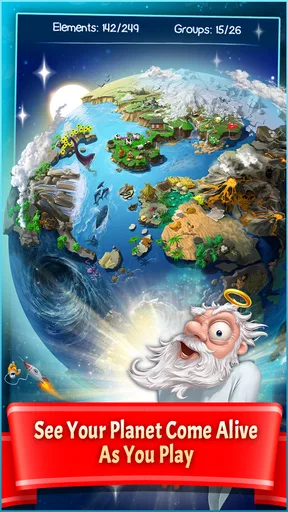
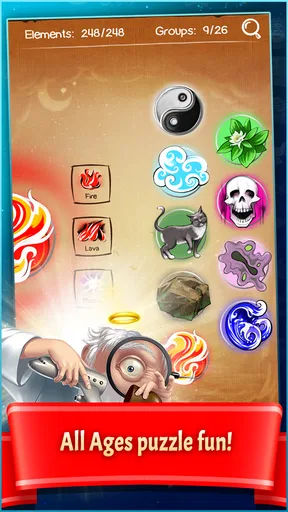
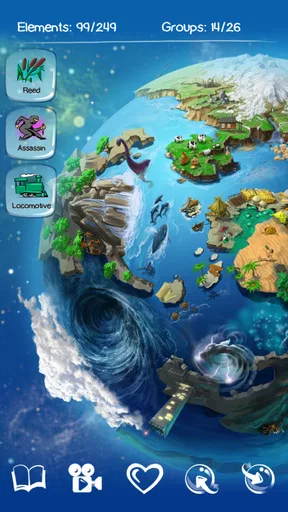
Our Review of Doodle God™
 Analysis by Appyee
On a quiet break, I like puzzle games that give me something to think about without demanding a long, uninterrupted session. Doodle God™ fits that mood with a simple premise: combine elements, see what comes of the experiment, and use each discovery to open up more possibilities. Its appeal is less about racing to a finish than enjoying the small surprise of a pairing that works.
That makes it a particular kind of creative puzzle game. You are not solving a fixed grid or matching identical pieces; you are testing ideas and building a chain of discoveries. I find that inviting, though it also means the fun depends on whether you enjoy wondering what might happen when two things meet.
Small early goals make it easy to begin
The opening is easy to understand: start with earth, air, fire, and water, then try combinations to create something new. There is no complicated strategy to learn before you can play. I can pick it up for a few minutes, make a couple of attempts, and put it down without needing to remember a long sequence of controls.
The first discoveries give the game its clearest early rhythm. Each successful combination turns a vague idea into a concrete result, and that result becomes another possible ingredient. The goal therefore grows naturally from “what can these basics make?” to “what can I do with what I just created?” That simple chain is the strongest reason I kept experimenting.
For a practical session, I would treat the early game as a series of small questions rather than try to solve everything at once. If a pairing does not work, switch to another idea and return later. This keeps experimentation playful instead of turning it into a checklist. It is also a useful approach for younger players: the basic task is easy to grasp, while the growing set of possibilities gives them room to think through cause and effect.
Progress feels tangible, but not always predictable
As combinations succeed, new groups and categories open up, and the world grows from basic substances toward ecosystems and civilizations. That change gives progress a satisfying shape: I am not merely collecting isolated answers, but seeing the scale of what I can make expand. New discoveries also provide a clear signal that an experiment has moved the puzzle forward.
There is a trade-off, though. The game’s logic can be playful rather than strictly scientific, so a combination that seems obvious to me may not be the one the puzzle accepts. I have to be willing to explore associations, not just apply real-world knowledge. When I get stuck, hints can point me toward a useful direction without immediately taking away the pleasure of solving the connection myself.
A good way to use those hints is to save them for a moment when several reasonable ideas have gone nowhere. Trying every imaginable pair can make the growing set of elements feel unwieldy; a nudge can restore momentum. I would not use help as the first response to every failed experiment, because part of the appeal is making the connection on my own. But there is little value in repeating the same guesses until the puzzle feels like busywork.
The difficulty curve rewards curiosity more than speed
The challenge rises as the number of discovered elements and possible pairings grows. At first, experimentation feels wide open. Later, remembering what is available and identifying a plausible relationship take more attention. The game is most enjoyable when I pause to think about what an element suggests, then test a small number of purposeful combinations rather than tapping at random.
That approach also makes the game a better fit for relaxed play than for someone seeking tightly tuned, competitive difficulty. Its satisfaction comes from connecting ideas and watching the collection expand, not from beating a timer or another player. If I want a puzzle with a single clear board state and a precise route to a solution, a conventional logic or match puzzle is a better choice. Here, uncertainty is part of the design, and patience matters more than speed.
What keeps me returning—and what can slow me down
The goals and unlocks give each session a reason to continue, but they do not make every stretch equally lively. A run of discoveries feels rewarding; a run of unsuccessful guesses can feel repetitive. I find the game works best in short visits, with enough time to follow a promising idea but not so much that experimentation becomes an obligation. It is an easy title to return to when I want a gentle mental diversion, rather than a game I need to play every day to keep up.
For example, I might open it during a quiet wait, try a few combinations based on something I have just made, and stop once I have found a new path to explore later. That is more satisfying than opening the game with the expectation that every session must deliver a major breakthrough. Its pace is self-directed, which is freeing, but players who need frequent, predictable rewards may find the less productive stretches frustrating.
Unleashing Your Inner Deity
Right from the get-go, Doodle God™ makes you feel like a mini-god. The interface is simple and intuitive, making it easy to jump right into the action. You start with the basic elements: earth, air, fire, and water. Your job is to mix and match these elements to create new ones. It sounds simple, but trust me, it gets delightfully complex as you progress.
As you successfully discover new combinations, you’ll unlock new groups and categories. Before you know it, you’re not just creating rocks and steam; you’re creating entire ecosystems and even civilizations. There’s something undeniably satisfying about starting with nothing but a handful of elements and watching your world grow.
Gameplay That Keeps You Hooked
What keeps Doodle God™ so engaging is its addictive gameplay loop. You’re constantly rewarded with new discoveries, many of which are accompanied by witty quotes or facts. This not only adds a layer of educational value but also keeps the experience light-hearted and fun.
The game doesn’t just leave you to your own devices, though. There are quests and challenges to guide your creativity, ensuring you’re always working towards a goal. And if you ever find yourself stuck, there are hints available to nudge you in the right direction without spoiling the fun.
Visuals and Sound that Draw You In
The art style of Doodle God™ is nothing short of charming. Each element is beautifully illustrated, with a whimsical style that makes the game feel like a living, breathing storybook. The vibrant colors and playful animations make each discovery feel rewarding.
And then there’s the soundtrack. It’s the kind of music that’s pleasant in the background without being intrusive, allowing you to focus on the task at hand. Combined with satisfying sound effects that accompany each new creation, the audio experience is just as delightful as the visual one.
A Few Words of Caution
While Doodle God™ is an absolute joy to play, it’s worth noting that the game does have in-app purchases. They’re not necessary to enjoy or complete the game, but for those who want to speed up their progress or access additional content, they’re available.
Occasionally, you might find some combinations to be less intuitive, which can result in a bit of trial and error. But hey, that’s part of the fun, right? After all, even gods make mistakes!
The purchase model is worth considering before you settle in. The game costs $1.49, and optional in-app purchases range from $0.99 to $99.99 per item. I would approach those extras as optional convenience rather than a reason to buy: the core pleasure is testing combinations and recognizing a new connection, so paying to move faster would not suit every player. If you prefer a puzzle that presents all of its content through one straightforward purchase, check the current purchase options on your platform before deciding.
It is also useful to set expectations around the word “educational.” The element combinations can prompt curiosity and playful reasoning, but I would not treat the game as a dependable science lesson. Its logic serves the puzzle, and some pairings are more whimsical than a classroom explanation. That makes it a nice shared activity for talking through ideas, but not a substitute for a factual reference when accuracy matters.
Who will enjoy this kind of puzzle?
I would recommend it to players who like open-ended experimentation, enjoy collecting discoveries, or want a puzzle that can be played in brief bursts. The Everyone content rating makes it accessible to a broad age range, and its basic interaction is simple enough for a family member to understand quickly. Playing together can make the guessing more interesting: one person can suggest a pairing while another explains the association behind it.
It is less suitable for anyone who dislikes trial and error or wants every puzzle to provide a clearly signposted solution. The expanding set of elements can make it harder to keep track of possibilities, and a run of unsuccessful combinations may feel like stalled progress rather than a challenge. If that sounds like you, a level-based logic game with defined clues and a visible end to each puzzle will likely feel fairer.
Compared with the usual match-three puzzle, this asks for associations rather than quick pattern recognition. Compared with a traditional word puzzle, it is more tactile and exploratory, but less precise about the answer path. That difference is important: Doodle God is at its best when I have a hunch and want to test it, not when I want a carefully bounded brainteaser with one obvious set of rules.
Practical details and a sensible way to play
JoyBits Ltd. developed the game, which sits firmly in the puzzle category. It has a 4.7 average from around 20,000 ratings, with about 1,900 written reviews, and has passed 500,000 installs. Those figures suggest a well-established audience, but they do not tell me whether its particular style will click for you; the key question is whether combining ideas sounds relaxing or irritating.
The current version is 3.3.16, and it requires Android 7.0 or later. It was released on December 24, 2010, so this is a long-running concept rather than a newly introduced puzzle. I would check that your device meets the operating-system requirement and keep the version in mind if you are comparing it with newer games. The same core appeal remains its chain of experiments and discoveries.
One small workflow tip is to think in families of ideas. When a new result appears, consider what it could plausibly connect to before switching to unrelated pairs. This narrows the search without turning play into a rigid plan. If a promising line dries up, use a hint or change direction instead of exhausting every possible pairing. That balance preserves the sense of discovery while reducing aimless tapping.
A relaxed progression, with a clear limit
In a busy day, I can imagine opening the game while waiting for a meal or taking a short break, making a few thoughtful combinations, and leaving with one new possibility to consider next time. The quests and challenges help give those sessions direction, while the growing collection of elements supplies a longer-term goal. The pacing does not demand that I keep playing, which is a strength for casual use.
Still, the same freedom means the game cannot guarantee a satisfying breakthrough each time I open it. Hints ease the rough patches, but they do not remove the underlying need to experiment. I would choose another puzzle if I wanted constant new levels, a strict difficulty ladder, or a sense of urgency. I would choose this one when I want to explore at my own speed and accept that some ideas will fail before one works.
Final Thoughts
In a world where games often focus on competition and stress, Doodle God™ offers a refreshing escape into a world of creativity and wonder. It’s a game that invites you to relax, experiment, and enjoy the simple pleasure of discovery. Whether you’re a seasoned gamer or someone looking for a casual escape, this game is sure to bring a smile to your face.
So why not give it a try and see what kind of world you can create? You might just find yourself playing god a little longer than you planned.
My progression verdict is positive, with one qualification: its goals and unlocks sustain curiosity best when I let them guide a few minutes of play rather than demand a steady march forward. The puzzle has a distinctive hook, a gentle pace, and enough room for personal theories, but it is not a fit for every puzzle fan. If discovery matters more to you than certainty, it is easy to see why so many players have stuck with it.
Verdict
Strengths of Doodle God™
- Engaging puzzle-solving mechanics.
- Creative combinations keep gameplay fresh.
- Visually appealing art style.
- Easy to pick up for casual players.
- Frequent updates add new content.
Limitations of Doodle God™
- Can become repetitive over time.
- In-app purchases can be intrusive.
- Ads might interrupt gameplay experience.
- Some combinations are unintuitive.
- Limited hints without purchase.
Other Releases by JoyBits Ltd.
View All
Doodle God™ HD
Puzzle4.2
Similar Picks in This Category
View All
Block Blast!
HungryStudio4.8

Braindom: Brain Games Test
Lahana Game Studio4.6

AMAZE!
CrazyLabs LTD4.6

Sudoku - Classic Sudoku Puzzle
Oakever Games4.7

Art Puzzle - Puzzle Games
Easybrain4.8

Amaze GO!
Oakever Games4.9
Frequently Asked Questions
What is Doodle God™ and how does it work?
Doodle God™ is a unique puzzle game where players combine different elements to create new ones, ultimately crafting the universe from scratch. Starting with basic elements like fire, water, earth, and air, you can unlock over 300 items and concepts. The game challenges your creativity and problem-solving skills as you discover new combinations.
Is Doodle God™ suitable for all ages?
Doodle God™ is designed to be accessible and entertaining for a wide audience, including both children and adults. The intuitive interface and simple mechanics make it easy for younger players to grasp, while the complex combinations and strategic thinking required can engage older players. However, it’s always a good idea to check the app’s age rating for specific guidance.
Does Doodle God™ require an internet connection to play?
Doodle God™ primarily offers offline gameplay, allowing you to enjoy the game without an internet connection. This makes it perfect for on-the-go entertainment. However, some features, such as updates or additional content downloads, may require an internet connection. Always check the app's requirements to ensure you have full access to all features.
Are there in-app purchases in Doodle God™?
Yes, Doodle God™ includes in-app purchases. These can range from buying hints to unlocking additional content or features. While the base game provides a comprehensive experience, these purchases can enhance gameplay or assist players who are stuck. It's important to manage in-app purchases, especially if children are playing.
How often does Doodle God™ receive updates?
The developers of Doodle God™ frequently release updates to improve the game, fix bugs, and add new content or features. Update frequency can vary, so it's recommended to keep an eye on the app store page for the latest information. Updates ensure a smooth experience and often introduce exciting new elements to the game.
Play our best games!


